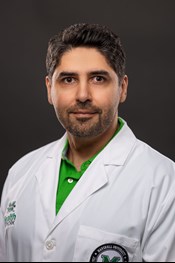


Mohammad Vahed, Ph.D.
Assistant Professor
vahed@marshall.edu
Innovative Computational Biologist and Bioinformatics Scientist specializing in artificial intelligence driven precision medicine and multi-omics data integration. My research focuses on developing interpretable AI models and web-based tools such as IRnet for immunotherapy response prediction, G2PDeep for multi-omics biomarker discovery, and the proposed WIRE platform for clinical decision support to advance cancer diagnosis and treatment. I bring over five years of experience combining computational modeling, machine learning, and biomedical data analysis to generate actionable biological insights from large-scale genomic, transcriptomic, and clinical datasets. Recognized for bridging computational innovation with translational medicine, I collaborate effectively with interdisciplinary teams of clinicians, biologists, and data scientists to accelerate discovery and improve healthcare outcomes.
• Proven expertise in developing advanced bioinformatics software, AI-driven analysis pipelines, and web- based platforms for precision medicine applications (e.g., IRnet, G2PDeep, WIRE).
• Strong interdisciplinary foundation in computer science, mathematics, and biostatistics, with specialized skills in multi-omics data integration and biomedical informatics.
• Extensive experience in genomic, transcriptomic, and proteomic data analysis, including GWAS, differential expression, and biomarker discovery for translational research.
• Advanced proficiency in machine learning and deep learning frameworks (TensorFlow, PyTorch) for predictive modeling, feature selection, and pathway-based biological interpretation.
1. Mohammad Vahed, Trupti Joshi. G2PDeep-v3: A Cell-Type and Sex-Aware Machine Learning
Platform for Phenotype Prediction from Single-Cell and Spatial Omics. in submission.
2. Nitesh Kumar Sharma, Ram Ayyala, Dhrithi Deshpande, Mohammad Vahed, et al. Analytical
code-sharing practices in biomedical research. PeerJ Computer Science 2024.
3. Fatemeh Mohebbi, Mohammad Vahed, et al. Assessing the robustness and reproducibility of
RNA-seq quantification tools. under revision.
4. Kerui Peng, Theodore Scott Nowicki, Katie Campbell, Mohammad Vahed, et al. Rigorous
benchmarking of T cell receptor repertoire profiling methods for cancer RNA sequencing.
Briefings in Bioinformatics 2023.
5. Kerui Peng, Jaden Moore, Mohammad Vahed, Jaqueline Brito, Guoyun Kao, Amanda M.
Burkhardt, Houda Alachkar and Serghei Mangul, pyTCR: A comprehensive and scalable
3solution for TCR-Seq data analysis to facilitate reproducibility and rigor of immunogenomics
research. Frontiers in Immunology 2022.
6. Vahed, M., Vahed, M., Garmire, L., BML: a versatile web server for bipartite motif discovery.
Briefings in Bioinformatics 2021.
7. Vahed, M., Vahed, M., Mirsaeidi, M., Sweeney, A., Shirazi, F.H., Trans-species evolution of
SARS-CoV2 via a mutation at position 32 (G>U) of S2M Motif.
8. Imani, S., Vahed, M., Vahed, M., (Corresponding Author) T-Ridership: a web tool for
reprogramming public transportation fleet to minimize COVID-19 transmission. SoftwareX
2023.
9. Vahed, M., Esmaelli, R., Vahed, M., Why Every Year Several New Cancer Drugs Go to Market
but There is no Cure Medicine for Alzheimer’s? are We Off-Target? J-Alzheimer’s
Neurodegener Dis2019, 6: 032.
10. Vahed, M., Ishihara, J., Takahashi, H., DIpartite: a tool for detecting bipartite motifs by
considering base interdependencies. PLoS ONE, 2019, 14(8): e0220207.
11. Vahed, M., Sweeney, A., Hirosh, S., Vahed, M., The initial stage of structural transformation of
Aβ42 peptides from the human and mole rat in the presence of Fe2+ and Fe3+: Related to
Alzheimer's disease. Computational Biology and Chemistry, Volume 83, December 2019,
107128.
12. Vahed, M., Ahmadiam, G., Ameri, N., Vahed, M., G-rich VEGE Aptamer as a Potential
Inhibitor of Chitin Trafficking Signal. Computational Biology and Chemistry, Volume 80, Pages
168-176, June 2019.
● Best Poster Award, International Symposium Organized by "Platform for Advanced Genome", The University of Tokyo, Tokyo, Japan, 2018
● Abstract Award, 7th Global Network Forum on Infection and Immunity, Chiba University, Chiba, Japan, 2018
● Young Investigator Award, 18th International Conferences of Bioinformatics and Engineering of Medicine, Miami, USA, 2016