After 50 years of service to Marshall University, Cindy Warren carries lessons of purpose and joy into retirement.
By Lacie Pierson
On the precipice of adulthood, 18-year-old Cindy Warren overheard a conversation that would change the trajectory of her life and that of thousands of doctors in the years to come.
It was 1966, about three years after a flood had destroyed the Warren family’s Logan County, West Virginia, home, leading them to purchase a new one on top of a mountain in their coal-driven community.
“I heard my aunt say to my mom that she couldn’t believe I was putting my family in such financial hardship by going away to school,” recalled Warren, who was just three weeks away from leaving Logan County to attend Marshall University when she overheard the conversation.
Instead of backing away from school or from her family, Warren set out to carve her own path through college — a path that eventually led her to provide invaluable support to thousands of doctors-in-training as assistant dean of admissions for what became the Marshall University Joan C. Edwards School of Medicine.
Warren retired from her position in December 2024. She left as quietly as her colleagues would let her.
“I told them I didn’t want any kind of going-away party,” Warren said. “I didn’t want anything. I’ve had my joy.”
 For nearly 50 years, it was Cindy Warren’s voice that communicated acceptance into the School of Medicine. It’s a voice so closely associated with the admissions process that Dean David Gozal, MD, MBA, PhD (Hon), made a recording of it, ensuring that Warren would continue to welcome students for years to come.
“Her legacy is part of the sense of community here, both at Marshall and in Huntington,” Dr. Gozal said. “It’s that sense that we’re all part of a greater community with larger goals — that we are here to serve the future and the well-being of everyone.”
For Warren, that sense of community grew out of her own academic and career journey.
That summer in 1966, just weeks before she was set to leave home, Warren reached out to the Logan County campus of what was, at the time, Marshall Community College. The outreach connected her with Jim Harless, director of admissions for the community college, who would go on to serve as director of admissions at Marshall University for 32 years.
Harless helped Warren secure tuition-free admission to the community college, allowing her to stay in her family’s home while still attending college. In the fall of 1969, she transferred to Marshall University’s Huntington campus, where she was one of the first co-directors of the Twin Towers dormitory during its opening year.
After graduation, Warren worked as a home economist for Columbia Gas in Beckley, West Virginia, before accepting an offer from her alma mater to be the director of Prichard Hall. She earned her master’s degree in counseling and rehabilitation while at Marshall and later worked in a variety of positions around Huntington, including at a law office and at a counseling facility that would eventually become Prestera.
Still, she had her heart set on admissions. Warren sometimes joined Harless on recruitment visits, where she found joy in helping students navigate the barriers standing between them and college.
“I really loved admissions, but nothing ever came up,” she said.
In 1977, Warren enthusiastically applied for what sounded like a dream job: director of admissions for a brand-new medical school at Marshall. She was not selected. But when the initial hire did not work out, Marshall posted a slightly different position, assistant director of admissions, which paid $5 more per month. This time, the offer went to Warren.
During the nearly five decades that followed, Warren’s expertise carried students from their entry into medical school through some of their toughest challenges, said Maurice Mufson, MD, who served as the first chairman of the Department of Internal Medicine at the School of Medicine.
“Cindy was the most effective and loved person at her job, and that’s why she had 50 years — because no one could come to be as well-versed and capable as she was,” said Dr. Mufson, now a professor emeritus at the School of Medicine. “She gave advice to lots of people, and her advice was always exceptionally good. She had a nice way of talking to people, explaining things. Everybody loved her.”
Vice Dean for Research Gary Rankin, MD, who’s been with the School of Medicine since 1978, described Warren as “the backbone for admissions.”
“Anyone who had a question about, or needed help with, the admissions process was directed by all of us to Cindy, who quickly and personably handled their questions and concerns,” Dr. Rankin said. “She helped thousands of students navigate the process of getting into our medical school and becoming part of the Marshall family.”
It was a matter of simple necessity that Warren began to call each newly accepted student. Yet as means of communication evolved to include texts and emails, she continued to believe a phone call was the best way to share the news.
“Not many schools still actually called people, but I decided that was the right thing to do,” Warren said. “It was such a fun part of what I did.”
Tuesday nights were reserved for making those calls. It was always a special moment, she said, though she learned a few hard-earned lessons.
“I did learn along the way — do not call on April Fools’ Day,” Warren said.
Former medical students remember Warren for her love for admissions, her counseling expertise and her ability to push through challenges.
“She was so unconditional in her support,” recalled Lisa Carchedi, MD (’00). “If you came in to talk, she would just listen to you. In medical school, it feels like everyone wants a little piece of you — they want you to study more; you’re doing this and that for a grade; you’re going to a lecture. Cindy didn’t want anything from you. You were a person, and she heard you.”
Rob Cure, MD (’98), added that Warren “had the voice of an angel.”
“Once you were part of the medical school, she was everything from your mother to your camp counselor when you had issues,” Dr. Cure said. “She was your big sister and your best friend to share your great times and sad times with. To say she had multiple jobs or wore many hats would be quite the understatement.”
While officially retired, Warren’s connection to the School of Medicine is far from over — she plans to attend Homecoming events for as long as she’s able, and she fully expects that to be a long time, she said.
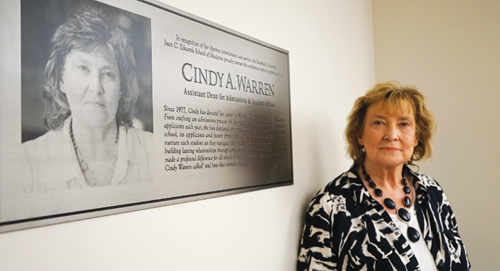
While she didn’t mind lending her name to the Cindy A. Warren Conference Room (only because it meant more scholarship support for students), Warren never sought the spotlight. She said her priority was always to usher students into and through the medical school process and find their purpose along the way.
That, she said, was where her joy came from — and what she hopes she left with the thousands of students she met over nearly 50 years at the School of Medicine.
“You have to be happy to wake up every morning and go to work,” Warren said. “I enjoyed doing the work. But all along, it was the students — that’s who I was working for.”
Photo caption: In recognition of Warren’s lifetime of service, a conference room was named in her honor in 2021.
Date Posted: Sunday, March 1, 2026