On the road to residency, every decision counts. Today’s students are navigating Match season in ways that look much different from years past.
By Angela Henderson-Bentley
Medical school is a journey of growth, discovery and endurance. From the thrill of acceptance and the pride of donning a white coat to the long nights of study and endless clinical responsibilities, each step leads to one defining moment: Match Day. The Match marks a medical student’s transition into residency — an exciting yet stressful milestone.
“It’s high stakes and high drama,” said Jay Shepherd, MD (’07), associate professor and chair of anesthesiology at the School of Medicine, which earned initial accreditation for a new anesthesiology residency in 2025. “I’ve heard it described as college admissions meets the NFL draft.”
The Match, or National Resident Matching Program®, uses an algorithm to match medical students with residency programs based on mutual rankings. Students compile their rankings in the spring after interviewing during the fall and winter.
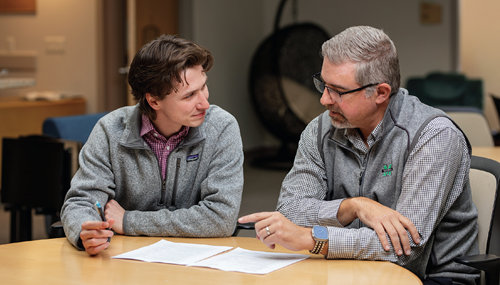
Student Alec Phelps, MS4, (left) credits his mentor Jay Shepherd, MD (’07), for helping him navigate the challenges of the Match.
“The unknown is the big thing,” said Alec Phelps, fourth-year medical student and president of the Class of 2026. “I’m a local West Virginia boy from Milton. Thinking about moving away is nerve-wracking.”
A recent addition to the Match process is program signaling, which lets students indicate interest in specific programs when applying. However, each specialty has only a limited number of signals available.
“You have to be strategic,” explained Marie Frazier, MD (’01), MSFS, associate dean for academic affairs. “If you don’t match with a program’s academic requirements, then signaling that program is a waste of a signal.”
The Match process has come a long way since the 1980s, when Karen Bledsoe was associate dean for external affairs at the School of Medicine. The students’ ranked lists had to be mailed in December for the March Match, and Bledsoe recalls the “horrific” scramble to get applications submitted.
“It was all due by fax, and there were so many people trying to reach the same fax numbers at the same time,” she said. “We called it fax gridlock.”
Today, the process is more digital — and more demanding. According to Shelvy Campbell-Monroe, PhD, MPH, senior associate dean for admissions, advising and student life, the criteria that residency programs consider have evolved significantly, especially since Step 1 of the United States Medical Licensing Examination became pass/fail. Research now plays a larger role for many specialties, she said.
“There’s definitely an emphasis on research, though how much depends on the specialty,” she said. “For example, orthopaedics has a very specific research requirement, while others may weigh different factors more heavily.”
She added that community service remains a key piece of the puzzle.
“Programs want to see applicants involved in some type of service, especially within the communities where they trained,” Dr. Campbell-Monroe said. “At Marshall, we’re looking for individuals who want to practice in rural areas — people who want to stay in West Virginia and serve our communities.”
While the balance of what matters most — grades, research, leadership or service — varies by specialty, together those experiences shape the well-rounded candidates programs are seeking, she said.
For Dr. Shepherd and the School of Medicine’s new anesthesiology residency, this year’s Match has been a revealing look at how complex and consequential the process is from the program’s side.
“Our current mission is to identify and match the best candidates possible while also looking for interest and connections to our school and area,” Dr. Shepherd said. “It’s exciting — it’s the result of a tremendous amount of work by multiple people to establish this program.”
Match Day, the culmination of the Match process, is held each year on the third Friday in March at medical schools nationwide.
“It’s memorable for students and their families, but it also gives us joy,” said Dr. Campbell-Monroe, noting that the match rate for School of Medicine students was 100% in 2024 and 99% in 2023. “It marks the transition into the next phase of training — the point where students can finally take everything they’ve learned and put it into practice.”
Across the country, Match Day happens simultaneously, usually at noon. At Marshall, the day includes a formal ceremony, lunch and family celebrations.
“All the students gather, we do a countdown and then they open their envelopes to find out where they’ll be doing their residency training,” Dr. Campbell-Monroe said. “It’s an incredibly emotional moment — one of the biggest days of their lives. The excitement in the room is contagious.”
Phelps noted that while the Match process has been challenging, it hasn’t come as a surprise, thanks to the guidance he’s received from alumni and older students. The School of Medicine actively cultivates these relationships, creating an informal mentorship community that connects current students with those who’ve already navigated the process.
That network becomes especially meaningful during the Match, said Dr. Shepherd, who serves as Phelps’ mentor.
“I hope that any alumni contemplating increasing their availability to mentor others will find it as rewarding as I do,” Dr. Shepherd said.
Date Posted: Thursday, March 19, 2026