Through new rural residency programs, the Joan C. Edwards School of Medicine is expanding access to care in central Appalachia.
By Katherine Pyles
Appalachia’s physician shortage is one of its greatest challenges. But at the Marshall University Joan C. Edwards School of Medicine, three new rural residency programs are preparing physicians to practice — and stay — in the communities that need them most.
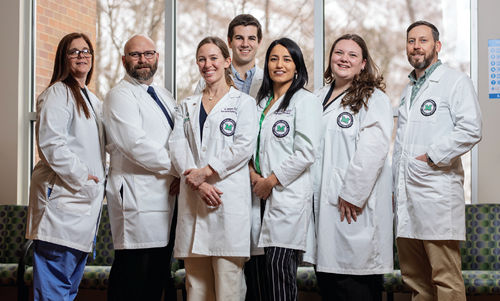
Rural general surgery residents spend more than half of their training at Logan Regional Medical Center under the guidance of longtime rural surgeons Jodi Cisco-Goff, MD, (far left) and James Paugh, DO (far right).
Marshall’s rural general surgery residency, the first of its kind in the nation, launched in 2023 at Logan Regional Medical Center, about 70 miles south of Huntington. The following year, the rural psychiatry residency began at Rivers Health in Point Pleasant, West Virginia, an area long lacking psychiatric providers. The rural internal medicine residency, West Virginia’s first and one of only three in the U.S., welcomed its first class in 2025 at Holzer Medical Center in Gallipolis, Ohio. Together, these programs create a pipeline of physicians trained to live and work in rural communities.
“Residents tend to stay close to where they’re trained, many within about 50 miles,” noted Adam Franks, MD, vice dean for rural health and professor and chair of family and community health. “If we train our residents in these rural areas, they’re going to become comfortable with the surroundings, with the referral patterns, with the patients — and maybe they’ll stay there.”
Local support has been instrumental in getting the programs off the ground.
“I can’t say enough about the physicians and administration at Rivers Health and how supportive they’ve been,” said Suzanne Holroyd, MD, director of the rural psychiatry residency and professor and chair of psychiatry and behavioral medicine.
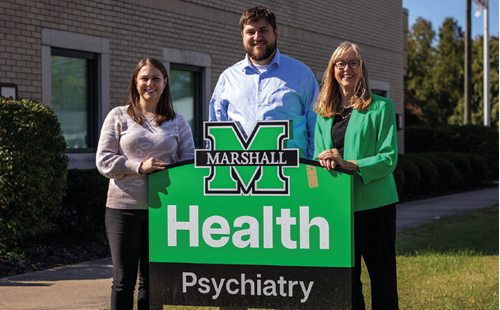
Second-year resident Thaddeus Martin, MD, (center) returned to his hometown of Point Pleasant to train in rural psychiatry and begin serving the community that shaped him.
Rural psychiatry residents rotate through internal medicine, family medicine, neurology and emergency medicine at Rivers Health before continuing their training in Huntington, where access to a wider range of specialties broadens their experience. For Point Pleasant native and second-year resident Thaddeus Martin, MD (’24), the program offered the chance to do exactly what he set out to do when he entered medical school: train as a psychiatrist and return to Mason County, West Virginia.
“I consider myself very lucky that I was coming up to start residency just as this program was getting off the ground,” Dr. Martin said. “It’s given me the opportunity to train where I grew up and start providing the care I always wanted to provide.”
Just across the river in Ohio, Holzer Health System is building on its existing partnership with the School of Medicine — which began with a family medicine residency established in 2015 — to welcome the inaugural class of rural internal medicine residents earlier this year.
“Residents will be able to go up to specialists and have a good, thorough conversation about treatment plans and diagnoses,” said Jennifer Calafato, DO, associate program director. “And since we’re such a small community, they’ll have a lot of one-on-one time with those specialists.”
In Logan, city officials are renovating downtown apartments to house Marshall’s rural general surgery residents during their training at Logan Regional Medical Center. Paulette Wehner, MD, vice dean for education, emphasized the importance of providing the residents — whose training extends beyond general surgery to include rural-relevant subspecialties like urology, OB/GYN and orthopaedics — with a place to rest and recover.
“These residents may have spouses; they may have children,” Dr. Wehner said. “Adequate housing is critical to meet their needs beyond the hospital walls.”
These programs reflect a common goal: improving health outcomes in rural communities by training physicians where they’re needed most. That commitment expanded in 2025 when Holzer joined as the second site for the rural surgery residency.
“Practicing medicine anywhere is not easy,” Dr. Franks said. “But practicing medicine in an area that doesn’t have the connectivity sometimes to get patients to specialists or to the proper care, or where you’re treating patients who lack the basic human needs that we take for granted — it’s really a testament to the heart that the people here at Marshall have for rural populations.”
Date Posted: Thursday, March 19, 2026